English
 français
 русский
 español
 português
 العربية
 Türkçe
 ไทย
ไทย Tiếng việt
 chinese
Symmetrical Tube Bending in Modern Manufacturing
Tube bending technology is widely used in modern manufacturing industries such as furniture production, automotive components, metal structures, and fitness equipment.
Many of these products require symmetrical tube shapes, where both sides of the part must maintain identical geometry and bending angles.
Producing these parts requires precise tube bending die design and accurate bending sequences.
Without proper tooling and process planning, symmetrical parts may suffer from dimensional deviations and structural inconsistencies.
Why Symmetrical Tube Bending Is More Complex
Compared with simple tube bending, symmetrical tube parts require a more precise bending strategy.
Several factors must be carefully controlled, including:
• bending angle accuracy
• tube positioning
• rotation between bends
• bending sequence
Even a small deviation during one bending step may cause the final part to lose its symmetry.
Therefore, engineers must carefully design the tube bending dies and bending process before production begins.
The Importance of Tube Bending Die Design
Die design is one of the most critical elements in tube bending.
A well-designed die set ensures that the tube remains stable during bending and maintains its cross-sectional shape.
Typical tube bending tooling systems include:
• bending dies
• clamp dies
• pressure dies
• anti-wrinkle dies
For symmetrical parts, die design must ensure that both sides of the workpiece maintain perfect geometric consistency.
High-quality tooling significantly improves bending precision and product quality.
Using 3D Simulation to Visualize the Bending Process
With the advancement of digital engineering, many manufacturers now use 3D tube bending simulation to analyze the bending process.
Through 3D models, engineers can visualize the bending process step by step before actual production.
This technology allows engineers to:
• evaluate bending feasibility
• optimize bending sequences
• avoid potential interference
• improve tooling design
By simulating the bending steps digitally, manufacturers can reduce trial production and improve manufacturing efficiency.
Step-by-Step Visualization of Symmetrical Tube Bending
3D simulation images are often used to demonstrate the bending process of symmetrical parts.
These visualizations typically show the transformation of the tube during several stages:
-
straight tube before bending
-
first bending operation
-
intermediate bending stages
-
final symmetrical shape
This step-by-step representation clearly illustrates how the tube moves and deforms during bending.
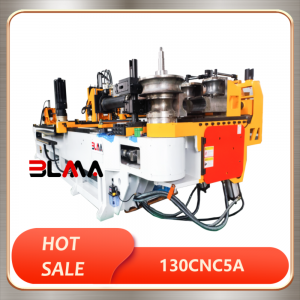
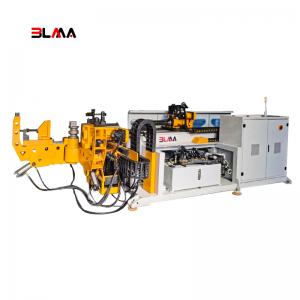
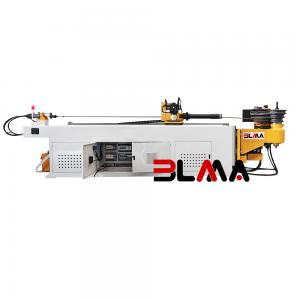
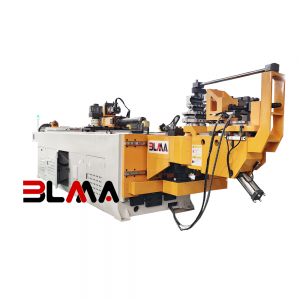
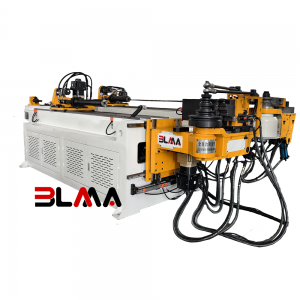
It also helps engineers and customers better understand the capabilities of CNC tube bending machines.
Applications of Symmetrical Tube Bending
Symmetrical tube bending is widely used in many industrial applications, including:
• furniture frames
• automotive structural components
• metal chair frames
• sports equipment
• architectural tubular structures
With advanced CNC tube bending machines and optimized die design, manufacturers can produce complex symmetrical parts with high precision and efficiency.
Conclusion
Symmetrical tube bending requires precise tooling design, accurate bending sequences, and advanced CNC tube bending technology.
By using 3D simulation and optimized tube bending dies, manufacturers can better control the bending process and ensure consistent product quality.
As digital engineering tools continue to evolve, simulation-driven tube bending design will become increasingly important in modern manufacturing.